





Inside a Modular Housing Project: Running 500 MCM, Reworking J-Boxes & More – with @speedyshark.electrician


USE CODE “Speedyshark10” to get 10% off your next Rack-A-Tiers order!
Hey there, @speedyshark.electrician here. I figured it’d be a good idea to give a quick chat about what is helping me be efficient and succeed in the field as an electrician of 9 years. I am currently a foreman on a project for a provincial low-income housing initiative. They are putting a bunch of modulars together on a Triodetic frame system, and we are reinstating all the wiring as it has been transported from another city and craned onto site. The cool thing about this site is that we have to build temporary power, which involves transformer work heading to the main distribution that controls all the branch circuits for the building, for the suite as well as house panels that handle general loads.
Keep Metal Shavings Out of Your Panel: Chip Catcher & Dirt Bag
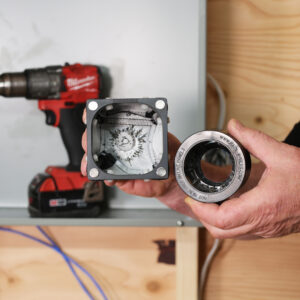 Just because we are using old disconnects and transformers that were shipped down to us doesn’t mean we don’t want them to stay clean. For cutting out my holes, I use either my Chip Catcher or my Dirt Bag, as they are inexpensive methods of keeping shavings out of electrical gear. Then I also use my trusty Milwaukee Vacuum to make sure I’ve cleaned all the gear I’m not cutting into, as I want to keep things tidy. Also, not many people know this, but Rack-A-Tiers has a nice set of carbide bits for cutting holes as well that I like to use if I don’t have a proper knockout kit.
How to Bend Heavy-Gauge Wire: Bend-All Sr. & Bulldog Bender
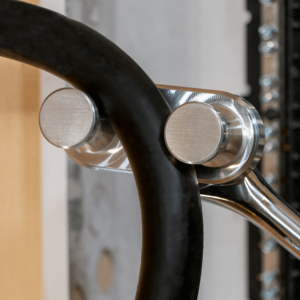 For these particular transformers, we are running parallel feeds of 500 KCMIL/MCM cable. It’s fairly rigid cable, and because I’m aging, even though I don’t like to admit it, I like using the Bulldog Bender to help me bend big cables. I was using the Bend-All for a while, but I found it to be a bit small for big cables, even though it works great for smaller ones. They have recently come out with a Bend-All Sr., which is quickly becoming a favorite because it is small for a tool bag but big in bending power. Just throw a ratchet on it or breaker bar and get to bending.
Easily Re-Color Wires with Mark My Wire
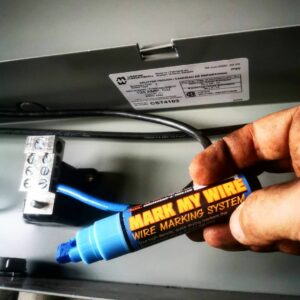 Inside, we are running all the branch circuits that go between the modulars, which require a lot of splicing and wire identification. The 208-volt loads often have a black wire and a white wire, so we need to re-identify the white wire as an ungrounded conductor, so no one mistakes it as a neutral conductor.
For this, I use the Mark My Wire markers. Some people complain about these, saying you get it on your hands, but I always mark one wire and move to the next and then go back, and I’ve never had an issue with it not drying quickly enough. There are also these obscenely massive junction boxes with a wild amount of NMD wire running into them. One box takes several hours to reconfigure, re-strip, and splice.
The Best Wire Strippers for Any Electrician

My favorite strippers right now are the Croc’s. I have the Jr. and the Sr., but the Jr.’s are my favorite with the added V-cutter attachment. Works perfect with NMD wire for stripping the sheath and the conductor insulation. Once everything is identified and in the box, it’s time to splice.
Check out the Croc's Wire Strippers
Wire Nut Twister that Saves Your Wrists
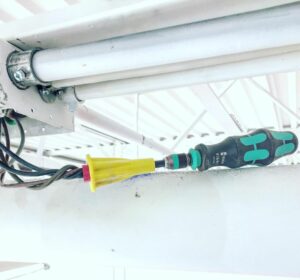 I know this tool gets a bad rap, but the Nut Blaster isn’t a tool you should stick your nose up at. If used properly and the wires are pre-spliced, it really cuts down on wrist fatigue when you are spending a full day splicing. Plenty of people hate on this tool because people over-tighten these connections, but if you use a proper torque-limiting tool or even put this attachment into a quarter-inch drive screwdriver, it really helps the process.
Finishing: Testing & Cleaning
After that, it’s troubleshooting and cleaning. There’s no substitute for my T6-1000pro Fluke multimeter, which stays on my hip for testing. That and a reliable plug tester. I either grab my Klein or Rack-A-Tiers plug tester.
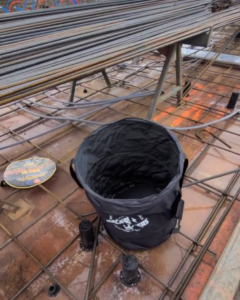 Then it’s a cleanup using the Exploding Garbage Can. This is easily one of my favorite things available. Yes, I am an electrician who cleans up after himself. The upgrade of the hard plastic bottom has helped out quite a bit though I wouldn’t throw it off a building to test it. If you treat it properly, it should last a long time. It’s great for hauling around and quick cleanups. I even got an extra one that I use for yard trimmings and vehicle clean up.
Keep the Site Clean with Exploding Garbage Can
I carry tons of tools with me, but I wanted to share a few tools and attachments that help make my life easier on site and make me more effective and efficient in the field.
USE CODE “Speedyshark10” to get 10% off your next Rack-A-Tiers order!

